A numerical example of how self-assessment liability is calculated

Here’s a numerical example showing how HMRC calculates your expected liability under Self Assessment


 Example: Calculating Expected Liability

Background

  • Your total tax and Class 4 National Insurance liability for 2023/24 (after PAYE and other credits) = £12,000.
  • You are self-employed and still trading in 2024/25, so HMRC assumes your next year’s liability will be roughly the same.

Step 1 – Work out the payments on account

Expected liability for 2024/25 is based on 100% of the previous year’s liability, split into two instalments:

[£12,000 × 50% = £6,000 \text{ per instalment}]

  • 1st Payment on Account (POA) – due 31 January 2025 = £6,000
  • 2nd Payment on Account (POA) – due 31 July 2025 = £6,000

You will therefore have paid £12,000 on account by 31 July 2025.


Step 2 – File the 2024/25 tax return

Suppose your actual tax liability for 2024/25 turns out to be £13,500.


Step 3 – Work out the balancing payment

[Actual liability (£13,500)} − \text{Payments on account (£12,000)} = £1,500]

That £1,500 is your balancing payment, due 31 January 2026.


Step 4 – Calculate next year’s payments on account

HMRC will now base your 2025/26 expected liability on this latest figure (£13,500), unless you claim to reduce it.

[£13,500 × 50% = £6,750 \text{ per instalment}]

So your next two payments on account will each be £6,750, due 31 January 2026 and 31 July 2026.


Step 5 – If your income drops

If you know your 2025/26 profits will be lower, you can apply to reduce your payments on account.
For example, if you expect your liability to fall to £10,000, you can claim to reduce each POA to:

[£10,000 × 50% = £5,000]

 If you reduce too much and end up owing more, HMRC will charge interest on the shortfall.
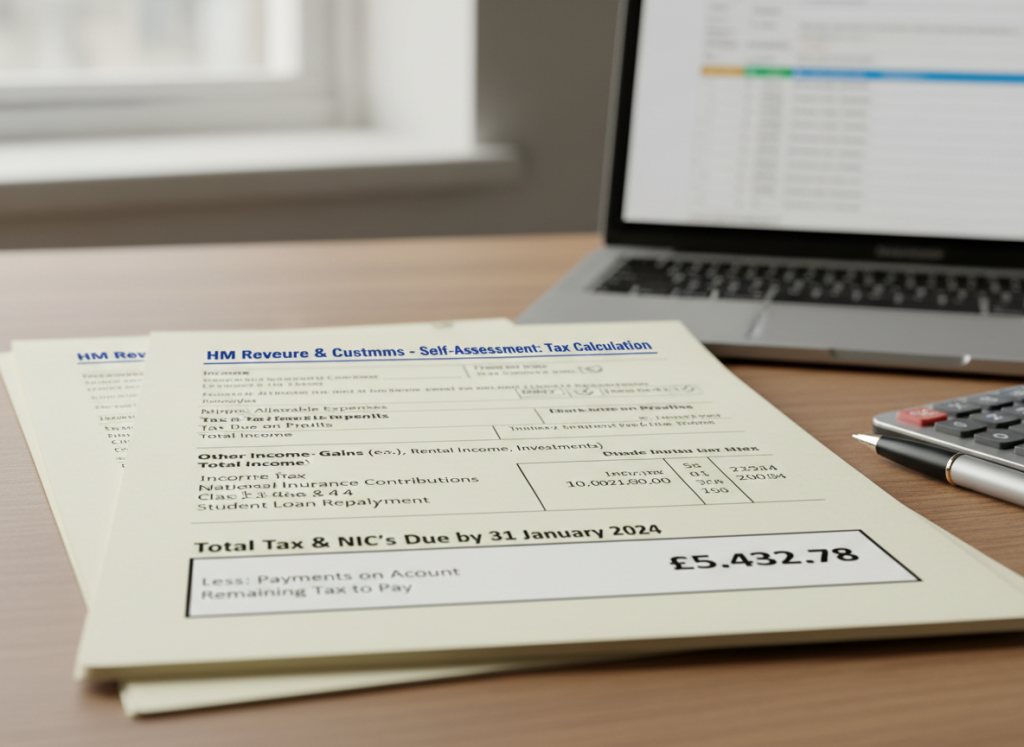

How is the expected liability under self-assessment calculated?

The expected liability under Self-Assessment (SA) is calculated based on statutory guidance outlined in Section 59A and Section 59B of the Taxes Management Act 1970, as referenced in your document.

Here’s how it works:

  1. Starting point – prior year’s liability
    HMRC calculates your expected liability for the current tax year using your previous year’s total income tax and Class 4 NIC liability, less any tax already deducted at source (for example, PAYE or CIS).
  2. Payments on account
  3. You are normally required to make two payments on account, each equal to 50% of the previous year’s net liability.
  4. Adjustments and balancing payment
  5. Once your Self Assessment tax return is filed, HMRC calculates the actual liability for the year.
  6. The difference between the actual amount owed and what has already been paid on account becomes your balancing payment, due by 31 January following the end of the tax year (Section 59B (1) – (4)).
  7. Reductions or claims
    You may make a claim to reduce your payments on account under Section 59A(3) and (4) if you reasonably expect your current year’s income to be lower
    However, excessive reductions made negligently or fraudulently can attract penalties under Section 59A(6).

So in summary:

Expected SA liability = 100% of the prior year’s net income tax and Class 4 NIC liability (excluding tax deducted at source), paid as two equal instalments on 31 January and 31 July.
Any remaining balance is paid the following 31 January once the actual figures are known.